
the science
"The Butterfly BVM exceeded the Ambu Spur II in delivering appropriate Vts and in keeping PIPs below target maximums to simulated adult and pediatric patients...."

Tidal volumes delivered to a pediatric manikin by participants using an Ambu Spur II pediatric vs the Butterfly BVM (set to the pediatric Vt setting). The green dashed line indicates the low threshold Vt (4 ml/kg) for a patient of the stated size (2 yr old child, 12–14 kg), and each red dashed line represents the max threshold Vt (8 ml/kg) for the same. **p < 0.01, 99 % CI (278 ± 8.69) ml.
Tidal volumes delivered to an adult manikin by participants using an Ambu Spur II adult vs the Butterfly BVM. The green dashed line indicates the low, threshold Vt (4 ml/kg) for a patient of the stated size (70 kg), and the red dashed line represents, the max threshold Vt (8 ml/kg) for the same. *p < 0.01, 99 % CI (278 ± 8.69) ml.

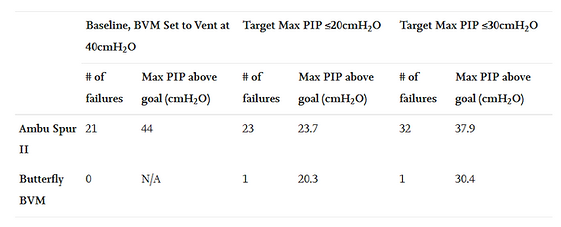
Number of failures (out of 1880 recorded breaths) in which participants delivered a peak inspiratory pressure above the target. Of note, there were only two failures when participants used the manometer-free Butterfly BVM
(each of which was less than 0.5cmH2O above target) in contrast to the 76 failures (and higher failure values) associated with use of the Ambu Spur II.

Click here for the full study.
there's more...
42 participants, MDs/DOs, RNs, and EMTs resuscitated a infant and adolescent manikin with the Ambu Spur II and the ButterflyBVM. Participants received no instruction on the use of the ButterflyBVM prior to being asked to use it.

"For both adolescent and infant mannequins, the median minute ventilations (MVs) were lower for the Butterfly BVM compared to the traditional BVM (Fig. 2). Target MVs occurred 73.8% of the time for the Butterfly BVM and 32.1% of the time for traditional BVM. Additionally, the odds of MVs being within target range were significantly higher for the Butterfly BVM compared to the traditional BVM (OR [95% CI] = 10.5 [4.1-26.5], p<0.001)."
"There was also a difference seen between professions. EMTs were within target range for MVs 72.7% of the time, nurses 70.0% of the time, and physicians 46.8% of the time. The odds of MVs being within target range were significantly higher for the EMTs than physicians (OR [95% CI] = 9.3 [1.6-54.7], p=0.02), and significantly higher nurses than physicians (OR [95% CI] = 7.4 [1.7-31.9], p=0.008)."
When users were asked to focus on PIP delivery, "there was improvement in MV delivery... for 21% (9/42) resuscitations using the Butterfly BVM compared to 4.7% (2/42) resuscitations using the traditional BVM. Additionally, MV delivery worsened after PIP intervention for only 7.1% (3/42%) of resuscitations using the Butterfly BVM compared to 21.4% (9/42) utilizing the traditional BVM."
Click here for the full study.

research sponsored by

National Science Foundation

